

EV Charger Installation in Minneapolis and St. Paul
You bought the car. Now you want to plug it in at home, wake up full, and stop thinking about it. That is a straightforward job, as long as the electrician looks at your whole electrical system first, not just the wall where the charger goes.
Randy’s Electric & Plumbing has served over 40,000 homeowners across the Twin Cities since 2002. Our licensed electricians install Level 2 home chargers in Minneapolis, St. Paul, and the surrounding suburbs, handle the permit and the inspection, and give you a fixed price before any work starts. We are available Monday through Saturday with same-day appointments in most of our service area.

Level 1 and Level 2: what the difference actually means for you
Level 1 is the cord that came in the trunk. It plugs into an ordinary 120-volt outlet and adds roughly three to five miles of range per hour. That is fine for a plug-in hybrid, or if you put ten miles a day on the car and it sits in the garage all night. It is not fine for a full battery-electric vehicle with a real commute. Plugged in from 6pm to 7am, Level 1 might return 40 to 60 miles, and less in a Minnesota January, with cabin heat and battery conditioning pulling from the same charge.
One caution on Level 1: the outlet has to be in good shape. Overnight charging is a continuous load, and continuous load is exactly what tired connections and 1950s receptacles do not tolerate. If you plan to run Level 1 for months, have the outlet and the circuit looked at.
Level 2 is what most people end up with. It runs on a dedicated 240-volt circuit, the same kind of supply your dryer or range uses, and typically adds 20 to 40 miles of range per hour depending on the charger and what the car can accept. Nearly every EV sold for home charging in the US uses either a J1772 or a NACS connector, and adapters are common, so the charger you buy is generally not locked to one brand of car.
We are not going to talk you into the biggest charger on the shelf. A 48-amp charger needs a 60-amp circuit and fills a battery faster, but if your car charges overnight anyway, a 40-amp charger on a 50-amp circuit does the same job and asks less of your panel. Sometimes the smaller charger is the reason you do not need a service upgrade at all.
Everyday Benefits Of Whole Home Surge Protector Installation
Almost every question about EV charger installation comes back to one thing: does your electrical service have room for the load?
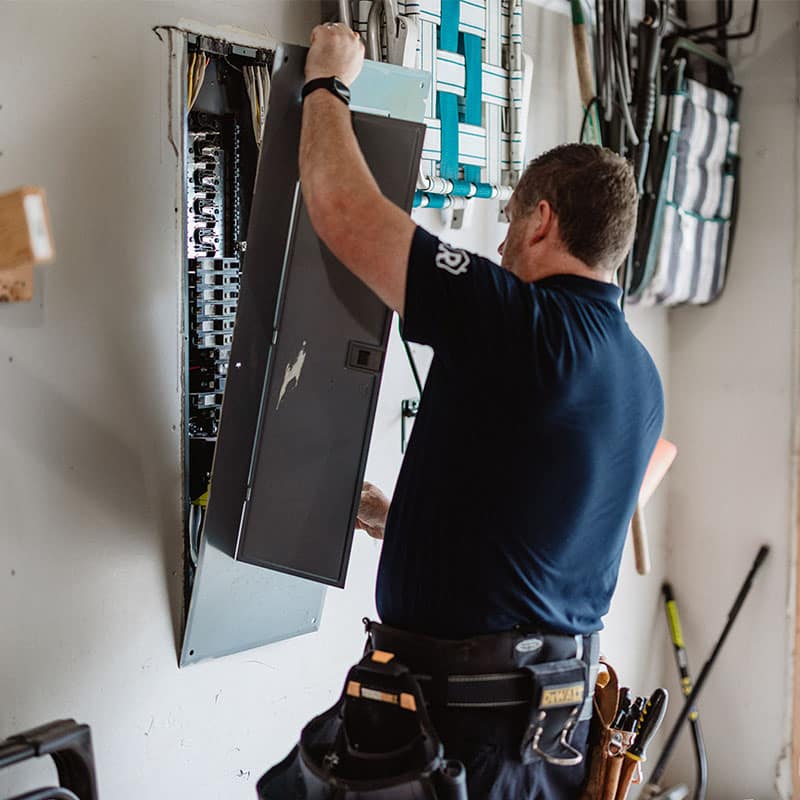
An EV charger is a continuous load, so the circuit has to be sized at 125 percent of the charger’s draw. A 40-amp charger needs a 50-amp breaker and conductors to match. Whether that fits depends on your service size, what else is already running on it, and how much of that capacity you actually use.
Here is how we work it out. We look at your panel: service size, how many spaces are open, whether the bus is in good condition, and what is already connected. Then, rather than guessing, we can use your home’s actual measured demand, the real peak it has drawn, instead of a worst-case calculation that assumes every appliance runs at once. Plenty of older Twin Cities homes on 100-amp service turn out to have room for a Level 2 charger once the numbers are on paper. Plenty of others do not.
When the capacity is not there, you have options, and they are not all “replace the panel”:
A panel that is full but otherwise healthy can sometimes take tandem breakers or a small subpanel instead of a full replacement. We will tell you which situation you are in before you commit to anything.

The detached garage reality in Minneapolis and the older suburbs
This is where Twin Cities EV installs differ from the generic advice online, and it is worth understanding before you get a quote.
Minneapolis has roughly 426 miles of alleys, and the City’s own Street Design Guide describes them as the primary loading access for most properties in the city. According to City of Minneapolis Assessor 2025 parcel data, 68.4 percent of single-family parcels in the city were built before 1940, and 78.9 percent before 1950. That era put the garage at the back of the lot, off the alley, rather than attached to the house. The City’s historic district documentation for Lynnhurst in southwest Minneapolis, built out between 1893 and 1937, says it plainly: most of those homes feature garages at the back of the lot. The same pattern holds across older St. Paul neighborhoods and the first-ring suburbs.
So for most Minneapolis homeowners this is not a matter of drilling through a garage wall next to the panel. It is a run to a separate structure across the back yard, and that carries its own code requirements:
The layout itself is no accident. The City’s own detached garage guidance generally expects a six-foot setback with the overhead door facing the alley, which is exactly why the garage sits where it does and why the feeder run is as long as it is. None of this is exotic: our Minneapolis electricians do it constantly, and the state fee schedule even carries a line item for feeders and circuits to separate structures. But it is why two houses three blocks apart get very different numbers for what looks like the same job, and why a phone quote for EV charger installation is not worth much.
Permits and inspection
EV charger installations require an electrical permit and a final inspection. That is not a formality. It is the record that the work was done to code, it matters if you sell the house, and it matters to your insurer.
Where the permit comes from depends on your city. In Minneapolis, electrical permits are issued by the State of Minnesota, through the Department of Labor and Industry, Electrical Licensing and Inspection Unit, rather than by the City. Other metro cities, including St. Paul and Minnetonka, run their own electrical permitting. We pull the permit for your city and meet the inspector.
On code: Minnesota enforces the 2023 National Electrical Code, and electrical permits filed on or after August 17, 2026 must comply with the 2026 NEC. The trigger is the date the permit is filed, not the date the work happens. We file under the correct edition either way.
What install day actually looks like
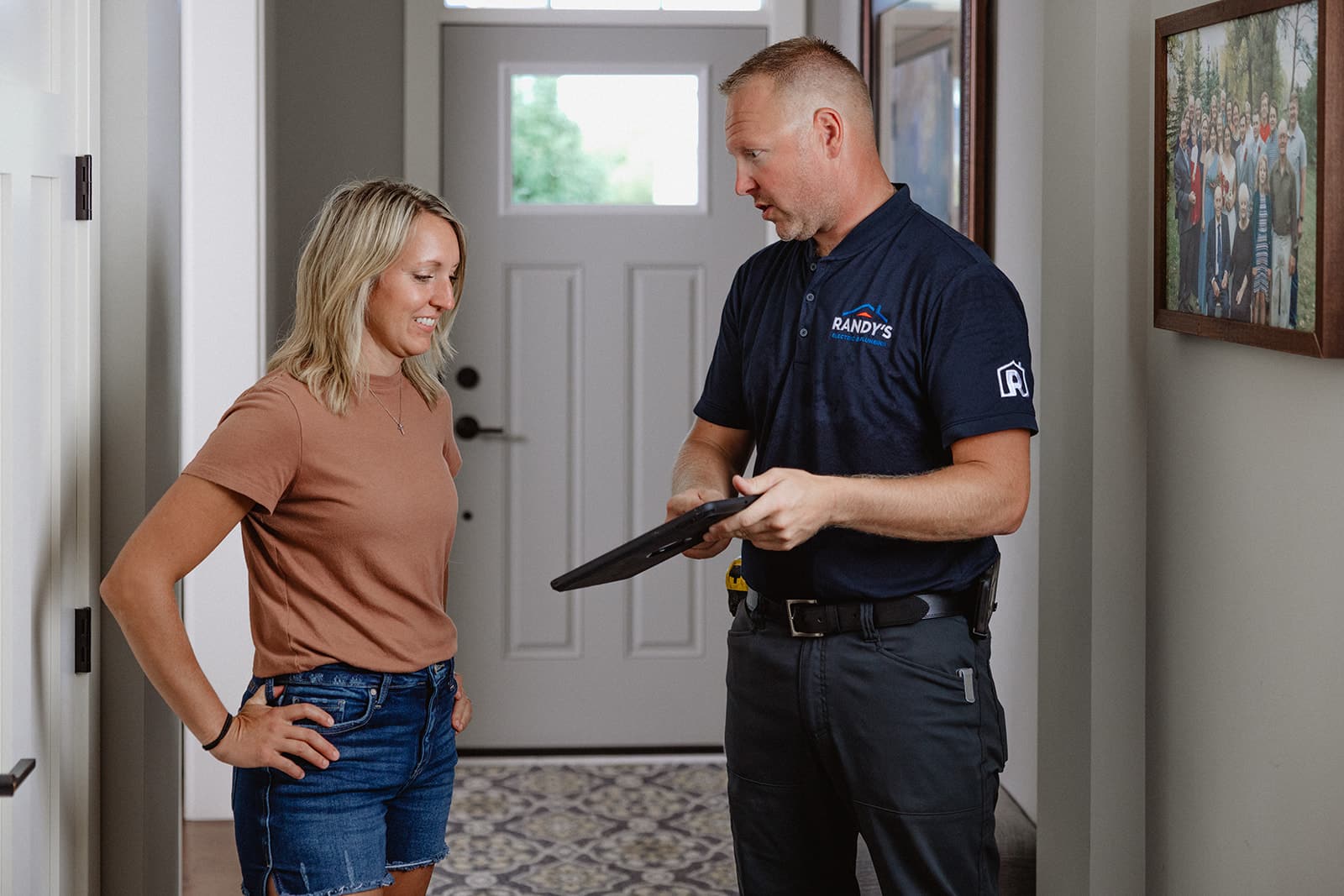
We come out, look at the panel, look at where you park, look at the route, and confirm the charger. You get a fixed price in writing before anything is scheduled. We diagnose first, you approve the price, and nothing gets added afterwards.
For a straightforward attached-garage job with capacity in the panel, we are usually there for two to four hours. Add a trench to a detached garage, a long run through a finished basement, or an exterior mount, and it takes longer, sometimes a second visit. We tell you which one yours is in advance, not on the day.
The sequence is roughly: shut off power at the panel, install the new breaker and run the circuit, mount and terminate the charger, restore power, energize, and test, including confirming the charger and the car actually handshake and pull current, because that is what you care about.
A plug-in charger on a NEMA 14-50 receptacle is flexible and easy to swap out. Hardwiring is generally better for higher-output units, for outdoor mounts, and where you want to avoid the nuisance tripping that can happen when a charger’s own ground-fault protection sits behind a GFCI device. Garage and outdoor receptacles require GFCI protection, so this comes up often.
We tidy up, walk you through the app and the charge schedule if your unit has one, and handle the inspection. If you are on an off-peak or EV rate, set the charger to match it.
Why Twin Cities homeowners call Randy's
Randy Smith started this company in February 2002. It is still family-owned. Our electricians are licensed, they are our own people, and they show up in the arrival window we gave you. We hold more than 6,000 Google reviews averaging 4.8 stars, which is less a slogan than a sample size.
We would also rather tell you your panel needs work before we install a charger than take the easy job and leave you with a house that trips every time the dryer and the car run together.
Call (763) 560-5600 or request an appointment. We are open Monday through Saturday, closed Sundays, with same-day service available in most of the metro.
Questions About EV Charger Installation? We’ve Got You Covered
Twin Cities homeowners have plenty of questions as they make the switch to electric vehicles. Below, we’ve answered some of the most common things people ask during the planning stage. If you want help choosing the right charger or understanding what your home needs, our licensed team is always happy to walk you through it.
Installation costs vary depending on your home’s electrical setup, the distance between your panel and charger location, and whether upgrades are needed. Most homeowners fall into a general range, but the big factor is whether your electrical panel has enough capacity.
We provide upfront pricing after a quick in-person evaluation, so you know exactly what to expect.
Sometimes. EV chargers draw more power than most appliances, so your panel needs enough amperage to support a dedicated 240V circuit.
You may need an upgrade if:
If an electrical panel upgrade is necessary, we’ll explain why and walk you through every option.Most chargers are installed in the garage, but outdoor installations are also common in the Twin Cities, especially for driveway parking. We look at:
We’ll help you choose a spot that’s practical, safe, and easy to access.For most homes, Level 2 installations take 2–4 hours once permits are approved. More complex projects, like long wiring runs, panel upgrades, and exterior installations, can take longer. We always give you an accurate time estimate ahead of your appointment and, when possible, complete the installation in a single visit.
Installing a Level 2 charger requires running a 240V circuit, ensuring code compliance, and navigating permits, and that’s work that legally must be done by a licensed electrician in most Minnesota cities.
DIY installations can lead to failed inspections, tripped breakers, panel overloads, or fire hazards. A professional installation ensures safety, proper grounding, long-term reliability, and peace of mind every time you plug in.
Yes, with the Level 1 cord that came with the car, which adds about three to five miles of range per hour. That works for a plug-in hybrid or a short commute. For a full battery-electric vehicle it usually does not keep up, especially in winter. If you plan to rely on Level 1 for a while, have an electrician check the outlet and the circuit, because overnight charging is a continuous load on wiring that may not have seen one before.
It is normal here, and no, it is not a problem. It is just a bigger job than an attached garage. With 68.4 percent of the city’s single-family parcels built before 1940 and roughly 426 miles of alleys behind them, the garage at the back of the lot is the Minneapolis default. It usually means trenching a feeder out to the garage, a disconnect and a ground rod at the garage, and a proper four-wire feeder. Older three-wire runs to a garage generally have to be replaced rather than reused. We look at the route and price the whole thing up front.
Yes. EV charger installations require an electrical permit and a final inspection. In Minneapolis the permit comes from the State of Minnesota, through the Department of Labor and Industry, Electrical Licensing and Inspection Unit, rather than from the City. Other metro cities, St. Paul and Minnetonka among them, issue their own. We pull it for you and meet the inspector.
Ask yourself how many miles you drive in a day and how many hours the car is parked at home. If the car sits from 6pm to 7am, a 40-amp charger fills it as completely as a 48-amp one does, on a 50-amp circuit instead of a 60-amp circuit. The bigger unit is worth it if you drive a lot of miles, run two EVs, or want the shortest possible top-up between trips.
We install customer-supplied chargers as well as units we provide. If you have already bought one, tell us the model when you call so we can size the circuit correctly before we come out.
EV Charger Installation You Can Count On
Your EV deserves a charger you can rely on, and so do you. With Randy’s, you get friendly guidance, expert installation, and a seamless experience that sets you up for safe, fast, and convenient charging for years to come. If you’re ready to make home charging effortless, our team is here to help.
