

Professional Electrical Troubleshooting & Diagnostics in Minneapolis, MN
Something in your house is not behaving, and you cannot see why. A breaker trips every few days with no pattern. Half a room went dead. A light flickers only when the furnace kicks on. Electrical troubleshooting is the work of finding the actual cause of that behavior, which is almost never sitting where you noticed the problem.
Randy’s Electric has been doing this across the Twin Cities since Randy Smith founded the company in February 2002. We are family-owned and licensed, and we hold more than 6,000 Google reviews averaging 4.8 stars. Call (763) 560-5600 or book online for same-day service where the schedule allows, Monday through Saturday.
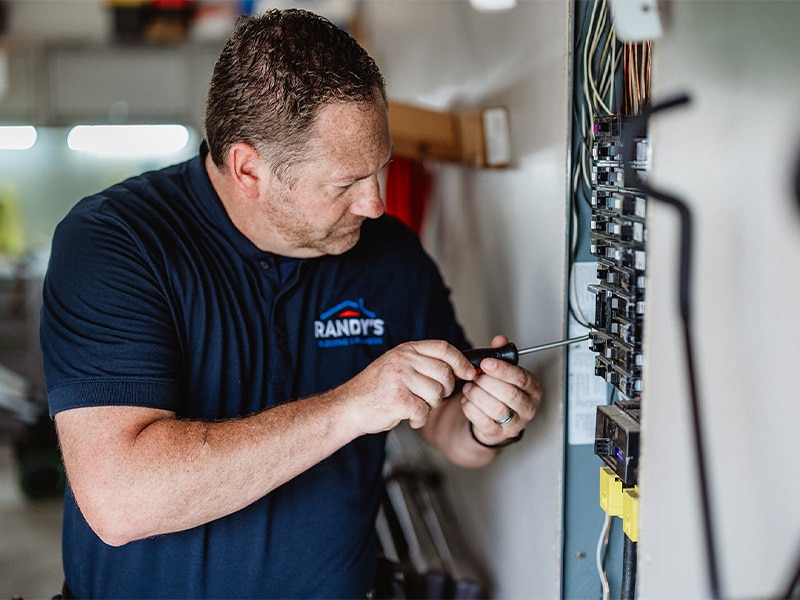
Why the symptom is rarely where the fault is
This is the single most useful thing to understand about home electrical faults, and it explains why swapping the part that misbehaves so often fails.
Electricity travels a whole circuit. A single circuit in a typical house might serve eight outlets, three lights, and a switch, threaded through joists and studs across two or three rooms. A fault anywhere on that path affects everything downstream of it. So the dead outlet in the bedroom may be perfectly healthy, and the actual failure may be a loose connection in a junction box behind a bookcase in the hallway.
Voltage drop works the same way. A connection that has loosened over decades of heating and cooling still passes some current, so the circuit half works. You see a dim light or an outlet that runs a lamp but not a vacuum. Replacing the light fixture changes nothing, because the fixture was never the problem.
This is why a good electrician starts with the circuit rather than the symptom, and why a diagnosis takes longer than a repair.
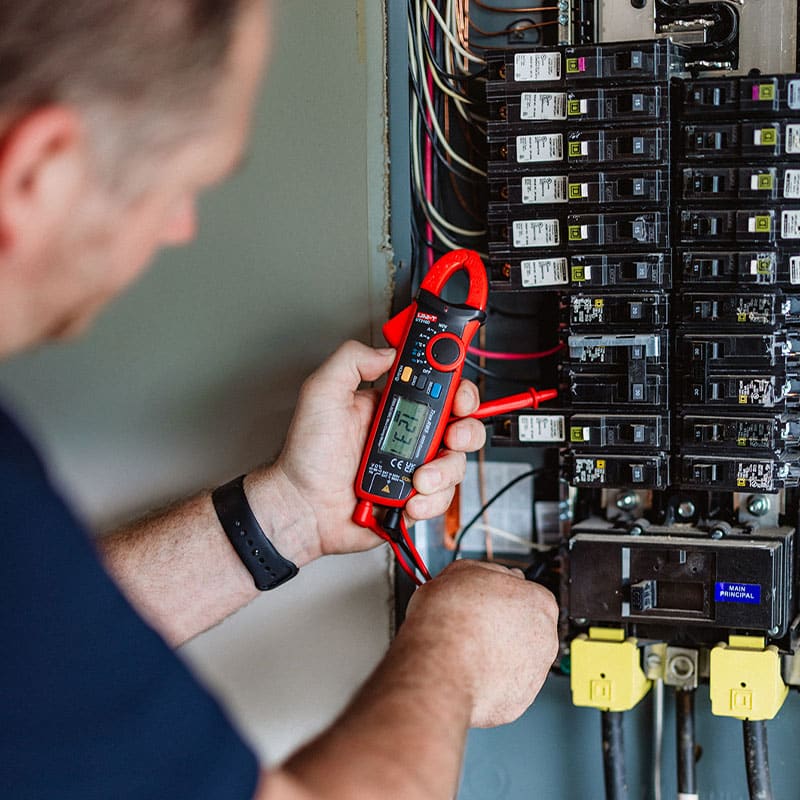
The instruments we use, and what each one actually tells us
Different instruments answer different questions, and using the wrong one produces a confident wrong answer.
Chasing an intermittent fault
Intermittent faults are the hardest work in this trade, and they are the calls most likely to have been given up on by someone else.
A fault that appears once a week will not perform on demand while an electrician is standing in the room. So we work on conditions rather than luck. We identify what correlates with the failure, load, temperature, humidity, vibration, or a specific appliance, and then we reproduce that condition deliberately. Loading a circuit to its rated draw will expose a loose connection that behaves perfectly at low current.
Thermal imaging is particularly valuable here, because heat accumulates before failure occurs. So is careful inspection of every connection point on the circuit, since an intermittent fault is very often a mechanical problem rather than an electrical one. A wire nut not fully seated, a backstabbed receptacle, or a terminal screw that was never fully torqued all behave exactly this way.
If a fault genuinely will not present itself, we will tell you that rather than guessing. Sometimes the honest answer is that we have narrowed it to a section, ruled out the dangerous causes, and need the fault to occur once more with monitoring in place.

What happens when the fault is inside a wall
This is the question homeowners most want answered before they call, so here is the direct version.
We open as little as possible, and never before we know where to open. The tracer, the tester, and the circuit map exist precisely so that we are not exploring. In most homes the fault turns out to be at a box, a device, or a splice, and those are accessible without cutting anything.
When access genuinely requires opening a wall or a ceiling, we tell you first, we show you why, and we agree the location with you before anything is cut. In plaster and lath houses, which describes a large share of older Minneapolis and St. Paul homes, we take extra care because plaster does not fail neatly. We cut clean, we contain the dust, and we leave the opening ready for patching.
Sometimes the better answer is to abandon a damaged run and pull a new one along an accessible path instead of chasing a fault through finished walls. We will present that option honestly with the tradeoffs, and let you choose.
What you receive at the end of the visit
A diagnosis you can act on, whether or not you have us do the repair.
You get a plain explanation of what we found and where, what caused it, and what will happen if it is left alone. You get a fixed price before any repair work starts, and nothing is added afterwards. You get told what we noticed that is not urgent, separated clearly from what is, so you can plan instead of react. If work needs a state permit, we tell you that too, because electrical permits in Minnesota are issued by the State, not by your city.
Minnesota now enforces the 2026 National Electrical Code, in force for permits filed on or after 17 August 2026. Where we find work that does not meet code, we will say so and explain what correcting it involves.
Book electrical troubleshooting in the Twin Cities
Tell us what the house is doing and when it does it. We will find the cause, explain it in language that makes sense, and price the fix before we start.
Call (763) 560-5600 or book online. Same-day service where the schedule allows, Monday through Saturday, across Minneapolis, St. Paul, and the surrounding metro.
Your Electrical Troubleshooting Questions, Answered by the Pros
Electrical issues are stressful, especially when you’re not sure what’s causing them. We’ve answered some of the most common questions Twin Cities homeowners ask when something stops working, starts buzzing, or just doesn’t feel right. If you’d rather talk it through with a real person, our team is always happy to help.
Some electrical issues are minor, but others are early warnings that your system may be unsafe.
Call a licensed electrician at (763) 560-5600 if you notice:
These symptoms often point to overloaded circuits, deteriorating wiring, or loose connections; all problems a professional should diagnose right away. If you’re unsure, schedule a troubleshooting visit so we can pinpoint the issue safely.A warm light switch is almost always a sign that something isn’t right. While dimmer switches can feel slightly warm during normal use, a switch that feels hot points to a deeper issue, such as:
A hot switch should never be ignored. Heat is one of the earliest signs of a potential electrical fire. Turn the switch off, avoid using the circuit, and schedule an inspection so a licensed electrician can pinpoint the cause and make repairs safely.Some electrical problems hide where homeowners can’t see them. Situations that may require further inspection include:
Electrical troubleshooting is part science, part detective work, and part safety training. Licensed electricians have the tools, experience, and certifications to diagnose issues accurately without putting your home or your family at risk.
DIY troubleshooting can lead to:
Most troubleshooting appointments take 60–90 minutes, depending on the complexity of the issue.
During your visit, your electrician will:
Troubleshooting is finding the cause. Repair is fixing it. They are separate pieces of work and often separate skills. A fault that takes an hour to locate can take ten minutes to correct, which is why we diagnose first and price the repair afterwards.
Because the outlet was probably not the fault. Everything downstream of a bad connection misbehaves, so the device you noticed is frequently healthy. The actual failure is often a loose connection in a box further up the circuit, sometimes in a different room.
It might be, but a breaker doing its job is far more common. Random tripping usually points to an overloaded circuit, a developing short, or a ground fault. A clamp meter tells us what the circuit is actually drawing, which settles the question quickly.
Usually no. We locate faults with circuit tracing and testing precisely so we are not exploring blindly, and most faults sit at accessible boxes and devices. If access genuinely requires opening a wall, we show you why and agree on the location with you before anything is cut.
Diagnosis itself does not. Repairs frequently do. Electrical permits in Minnesota are issued by the State, through the Department of Labor and Industry, not by your city. We pull the permit and see the inspection through on work that requires it.
Because circuits in older homes have usually been extended, modified, and rewired over many decades, often without permits or documentation. Panel labeling rarely matches reality. Mapping the circuit accurately is itself a meaningful part of the visit.
Get Reliable Answers to Your Electrical Problems
Electrical issues don’t get better on their own. If something feels off, our team is ready to diagnose the problem and get your home back to safe, dependable operation. We’re here to make troubleshooting simple with friendly guidance, honest pricing, and workmanship you can trust.
