

Electrical Repair for Twin Cities Homes
Something in your house is not working the way it should. An outlet went dead. The kitchen lights dim when the microwave runs. A breaker keeps tripping and you are tired of walking down to the basement to reset it. You want it looked at by someone who will find the actual cause, tell you plainly what it is, and fix it.
That is what this is. Our licensed electricians diagnose the problem first, show you what we found, and give you a fixed price before any work starts. Nothing gets added to that price afterwards. We have served over 40,000 homeowners with electrical work across the Twin Cities, and we hold more than 6,000 Google reviews averaging 4.8 stars. Same-day appointments are available Monday through Saturday.
Schedule Your Service

Do I Need a Professional Electrician? Signs It’s Time to Call Randy’s
Most electrical repair calls in the metro fall into a short list. If yours is on it, we have seen it many times this month alone. The mix shifts with the season: dead outlets and outdoor circuits in spring and summer, tripping breakers and warm devices once the space heaters, block heaters and roof heat cable come out in November.
How we find the fault instead of guessing
Replacing parts until something works is expensive, and it does not tell you whether the underlying problem is gone. We work the other direction.
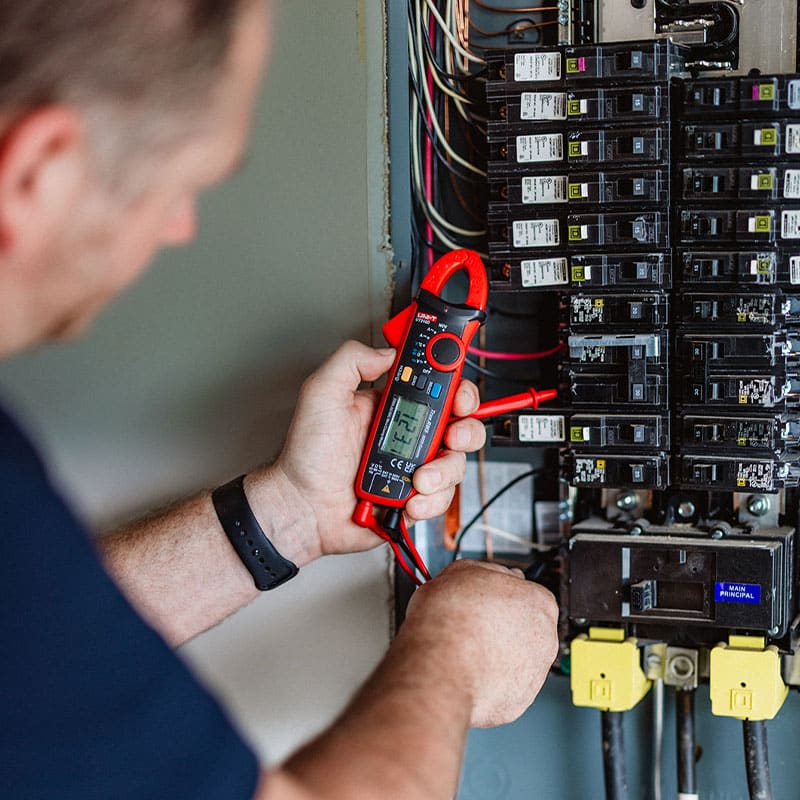
An electrician arrives, listens to what you have noticed and when, and then traces the circuit. We open the panel and check the connections and the breaker itself. We test voltage under load, not just at rest, because a loose connection often reads fine until current flows through it. We check the devices on the circuit (outlets, switches, junction boxes) for heat, arcing marks, backstabbed connections and reversed or missing grounds. Where a fault is intermittent, we look for the conditions that bring it on rather than declaring it fixed because it stopped for ten minutes.
When we find it, we show you. Then you get a fixed price for the repair before we pick up a tool, and you decide.
Why older Minneapolis and St. Paul homes generate more of these calls
This is not a vague claim about old houses. City of Minneapolis Assessor parcel data for 2025 puts 51,513 of the city’s 75,257 single-family parcels, 68.4 percent of them, at a build date before 1940. Push the line to 1950, and it is 78.9 percent. Add 10,587 duplex parcels and 963 triplex parcels, a great many of them older single-family houses divided up later, and you have a city wired for a few lights, a radio and a refrigerator now carrying a microwave, a window air conditioner, a home office, a gaming setup and sometimes a car charger.
That shows up in predictable ways. Two-prong ungrounded outlets are common in homes wired before grounding was standard. Original circuits are often shared far more widely than a modern kitchen or laundry would allow, and in a duplex the two units frequently share more than either household realizes.
The same parcel data shows 4,439 Minneapolis parcels built between 1965 and 1973, about 3.8 percent of the stock. That narrow band is worth knowing about, because it lines up with the years aluminum branch circuit wiring was installed, roughly 1965 to the mid-1970s. The Consumer Product Safety Commission has studied it closely: homes built before 1972 with aluminum branch wiring are 55 times more likely to have connections reach what the CPSC calls Fire Hazard Conditions. It is repairable, but only with an approved permanent method, meaning full copper replacement, COPALUM crimps, or AlumiConn connectors. Twist-on wire nuts and CO/ALR devices are not approved repairs for it. We wrote more about that in our Is aluminum wiring safe article.
Then add the winters. Eighty or ninety heating seasons of expansion and contraction at every terminal, decades of DIY additions, a house settling around its wiring, and a January load the original circuits were never asked to carry: a space heater in the back bedroom, heat cable on the roof edge for ice dams, an extension cord out to the block heater. You get loose connections. Loose connections are the single most common root cause behind flickering, warm devices, and intermittent dead circuits, and cold weather is when they announce themselves.
Garage, alley and outdoor circuits
Minneapolis has roughly 426 miles of alleys, and the City’s Street Design Guide describes them as the primary loading access for most properties in the city. That is why so much of the city’s garage stock sits at the back of the lot with an overhead door facing the alley, generally on a six-foot setback. The City’s own records for Lynnhurst in southwest Minneapolis note that most houses there feature garages at the back of the lot, and the pattern repeats across the older neighborhoods.
Electrically, a detached garage is a separate structure, and the feeder running out to it is its own piece of work rather than an extension of a basement circuit. Minnesota’s electrical permit fee schedule carries a line item for feeders and circuits to separate structures, which tells you how routinely it comes up. The calls we get from the alley side of the lot are consistent: a garage that has lost power entirely, a buried feeder that has failed, an extension cord doing a feeder’s job across the yard, an exterior receptacle whose GFCI will not hold after rain or snowmelt, and a heated garage or block heater tripping a circuit that was fine before the temperature dropped.
When it is a repair, and when the system is telling you something bigger
We would rather fix one outlet than sell you a panel you do not need. Most calls really are one bad device, one loose connection, one failed breaker.
But sometimes the repair is a symptom. If breakers on different circuits keep tripping, if you cannot run the microwave and the toaster together, if the panel is full and every slot is doubled up, if the lights dim every time the furnace or the well pump starts, or if you are still on a fuse box or 60-amp service, the honest answer is that the system is undersized or worn out rather than broken in one spot.
In that case, we will tell you so, explain what an electrical panel upgrade or rewiring work would involve, and let you decide on your own timeline. A repair that keeps coming back is not a bargain.
Electrical Repair Service FAQs
It depends entirely on the cause, which is why we diagnose before quoting. An electrician finds the fault, shows you what it is, and gives you a fixed price for the repair before any work starts. Nothing is added to that price afterwards. You are free to say no.
Usually, yes. We offer same-day appointments Monday through Saturday and keep capacity open for urgent calls. We are closed Sundays. If you have a burning smell, sparks, a warm panel or exposed wiring, call (763) 560-5600 right away rather than booking online.
In Minnesota, most electrical repairs must be performed by a licensed electrician, and the work must meet the Minnesota Electrical Code. Permits and inspections are often required to verify safety and compliance. Homeowners may handle only very minor tasks.
Major repairs, replacements, or new installations should be left to licensed professionals to avoid hazards, failed inspections, or insurance issues. For code-compliant electrical repair in Minneapolis, St. Paul, and the surrounding metropolitan area, book a visit, and we will handle permits and testing.
Most often, a GFCI outlet somewhere else on the circuit has tripped and cut power downstream. Check bathrooms, the kitchen, the garage, the basement and outdoor outlets. If no reset restores it, the likely cause is a failed device or a loose connection in a box on that circuit.
Yes. Faults waste energy and shorten appliance life. Usual culprits are:
Our Twin Cities electricians can track down the source, balance loads, and recommend repairs or upgrades that improve efficiency. If your bills have crept up with no clear reason, schedule an electrical inspection. We will run checks and give you options for enhancing the energy efficiency of your home.
Generally no. Minnesota law requires licensed electricians or electrical service professionals for repairs, installations, and upgrades, with permits and inspections to confirm the work meets the Minnesota Electrical Code. Using an unlicensed handyman can create safety risks, fail inspection, and jeopardize insurance coverage.
Our Twin Cities electricians handle troubleshooting, outlets and switches, breaker and panel work, and wiring repairs the right way. We explain what we find, share pricing before we start, pull permits when required, and finish to code so your Minneapolis or St. Paul home is safe, compliant, and good to go.
Yes. First, we make the area safe, then we bring the work up to Minnesota code. That may include:
Whatever DIY project went wrong, we’ll make sure you see pricing before we begin the fix and get neat workmanship backed by our quality workmanship.
No. The breaker is sized to protect the wire behind it. A larger breaker lets more current flow through wire that was never rated for it, and the wire inside your walls, where you cannot see it, becomes the weakest point. Repeated tripping needs to be diagnosed. See our circuit breaker services page.
Not simply by swapping the device. That would give you a three-prong outlet with no ground behind it, which is worse than what you have because it looks safe and is not. The proper fixes are running a ground, rewiring the circuit, or when allowed, protecting the outlet with a GFCI and labeling it correctly. An electrician can tell you which applies at your house. See outlets and switches.
Yes, using approved permanent methods only: full copper replacement, COPALUM crimp connectors or AlumiConn connectors. We do not use twist-on connectors or CO/ALR devices on aluminum branch circuits, because the CPSC does not accept them as permanent repairs.
Dependable Electrical Repairs in Minneapolis-Saint Paul Start Here
Choose licensed electricians who listen first, troubleshoot carefully, and finish to Minnesota code. We protect your space, clean up, and keep you informed from start to finish. Schedule an appointment and enjoy safer, steadier power throughout your Twin Cities home.
