

Commercial Electrical Repair for Twin Cities Businesses
An outlet behind the sales counter has gone dead. The lights in the office flicker every time the HVAC unit kicks on. A breaker in the mechanical room keeps tripping, and a staff member has been resetting it by hand all week. Or power has dropped across a whole tenant suite and no one can say why. You need someone who will find the actual cause, explain it in plain terms, and get your space back up and running with as little interruption to your operations as possible.
That is what we do. Our licensed electricians diagnose the problem first, walk you through what we found, and provide a project-based quote before any work begins. We have supported offices, retail stores, restaurants, warehouses, and clinics across the Twin Cities for more than 20 years, and we schedule around your business hours whenever we can, including same-day service where available.
Request a Service Visit

Do You Need a Commercial Electrician? Signs It Is Time to Call Randy’s
Most commercial electrical repair calls we take fall into a familiar pattern, whether the building is a strip mall, a clinic, or a warehouse. The specifics shift by season and by business type, but the underlying causes are usually the same handful of things.
How We Find the Fault Instead of Guessing
Swapping parts until something works costs you money and still leaves you wondering whether the real problem is gone. We approach it the other way around.
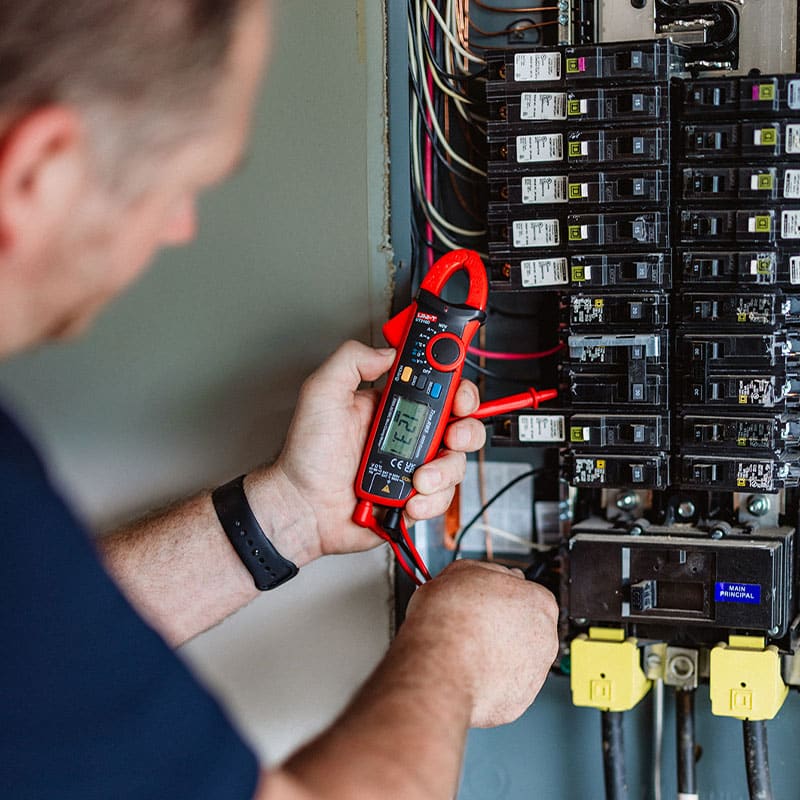
An electrician arrives, asks what your staff has noticed and when, and then traces the circuit from end to end. We open the panel and check the connections and the breaker itself. We test voltage under load, not just at rest, because a loose connection can read fine until current is actually flowing through it. We check the outlets, switches, and junction boxes on the affected circuit for heat, arcing, and loose or damaged connections. If the issue is intermittent, like a suite that loses power only at certain times of day, we look for the pattern behind it rather than calling it fixed because it stopped for a few minutes.
Once we find the cause, we show you. Then you get a clear quote for the repair before we start, so you can plan around your schedule and your budget.
Why Commercial Buildings in Minneapolis and St. Paul Generate These Calls
A large share of commercial space in the Twin Cities sits inside buildings that were constructed, converted, or last rewired decades ago. Storefronts in older retail corridors, offices carved out of former warehouses, and restaurants operating in buildings that started life as something else all carry electrical systems that were sized for a different era of equipment and a different mix of tenants.
That history shows up in predictable ways. Circuits in older commercial buildings are often shared more broadly than current loads call for, and in multi-tenant buildings, two suites sometimes draw from the same circuit without either tenant realizing it. Panels in mechanical rooms and back-of-house areas are frequently undersized, poorly labeled, or carrying connections that have loosened over years of equipment changes, remodels, and added circuits.
Winters add their own stress. Heating and cooling cycles expand and contract wiring connections at every terminal year after year, and a January load, space heaters in a back office, a walk-in cooler compressor, holiday lighting on a storefront, can push an older circuit past what it was ever asked to carry. Loose connections are the most common root cause behind flickering lights, warm devices, and circuits that fail intermittently, and cold weather is often when they finally announce themselves.
Mechanical Rooms, Loading Docks & Exterior Circuits
Many commercial properties route a meaningful share of their electrical load through back-of-house areas: mechanical rooms, loading docks, storage areas, and exterior circuits serving signage, parking lots, and dock doors. These areas see less daily attention than the sales floor or the front office, so problems there can go unnoticed until a circuit fails outright.
A detached storage building or a separate structure on the property is its own piece of electrical work, not an extension of the main building’s wiring, and the feeder running to it needs to be sized and protected on its own. The calls we get from these areas follow a pattern: a loading dock that has lost power entirely, a buried feeder that has failed, an extension cord doing a feeder’s job across a yard or lot, an exterior receptacle whose GFCI will not hold after rain or snowmelt, and heated storage areas tripping circuits that were fine before the temperature dropped.
When It Is a Simple Repair, and When the System Is Telling You Something Bigger
We would rather fix one outlet than recommend a panel upgrade you do not need. Most service calls really are one bad device, one loose connection, or one failed breaker.
But sometimes the repair points to something larger. If breakers on different circuits keep tripping, if equipment in the kitchen or break room cannot run at the same time without a trip, if the panel is full with every slot doubled up, or if the lights dim every time a rooftop unit or compressor starts, the honest answer is that the system is undersized or aging rather than broken in one spot.
When that is the case, we will tell you plainly, explain what a panel upgrade or additional circuits would involve, and let you plan the work around your budget and your tenants’ schedules. A repair that keeps coming back costs more than addressing the cause.
Commercial Electrical Repair FAQs
It depends on the cause, which is why we diagnose before quoting. An electrician finds the fault, shows you what it is, and provides a project-based quote for the repair before any work starts. There are no surprise additions once work is underway, and you decide whether to move forward.
In most cases, yes. We coordinate scheduling with property managers and business owners to minimize disruption to staff, customers, and tenants, and we offer same-day service where available. If you have a burning smell, sparks, a warm panel, or exposed wiring, call (763) 560-5600 right away rather than booking online.
In Minnesota, most electrical repairs must be performed by a licensed electrician, and the work must meet the Minnesota Electrical Code. Permits and inspections are often required to confirm the work is safe and compliant. In-house staff can typically handle only very minor, non-electrical maintenance tasks.
Repairs involving panels, circuits, or wiring should go to a licensed contractor to avoid safety hazards, failed inspections, or issues with your insurance coverage. For code-compliant commercial electrical repair in Minneapolis, St. Paul, and the surrounding metro, schedule a visit, and we will handle permits and testing as needed.
Most often, a GFCI outlet elsewhere on the same circuit has tripped and cut power downstream. Check restrooms, break rooms, kitchens, and exterior outlets for a reset button. If no reset restores power, the likely cause is a failed device or a loose connection somewhere on that circuit.
Yes. Faults waste energy and shorten the life of equipment. Common culprits in commercial buildings include:
Our Twin Cities electricians can track down the source, balance circuit loads, and recommend repairs or upgrades that improve efficiency. If your utility bills have crept up with no clear explanation, ask about a commercial electrical inspection. We will test your system and lay out options for improving efficiency.
Generally, no. Minnesota law requires licensed electricians for electrical repairs, installations, and upgrades, with permits and inspections to confirm the work meets the Minnesota Electrical Code. Using an unlicensed worker can create safety risks for staff and customers, fail inspection, and put your insurance coverage at risk.
Our Twin Cities electricians handle troubleshooting, outlets and switches, breaker and panel work, and wiring repairs correctly the first time. We explain what we find, share pricing before we start, pull permits when required, and finish to code so your property stays safe and compliant.
Yes. First, we make the area safe, then we bring the work up to Minnesota code. That may include:
Whatever work needs correcting, we will walk you through pricing before we begin and leave the space with clean, code-compliant workmanship your next inspection will not flag.
No. The breaker is sized to protect the wire behind it. A larger breaker allows more current to flow through wire that was never rated for it, and the wiring inside your walls, where no one can see it, becomes the weak point. Repeated tripping needs to be diagnosed rather than worked around. See our commercial circuit and breaker services page.
Not by swapping the device alone. That would leave you with a three-prong outlet and no ground behind it, which is worse than what you had because it looks safe and is not. The proper fix is running a ground, rewiring the circuit, or, where allowed, protecting the outlet with a GFCI and labeling it correctly. An electrician can tell you which applies in your building. See outlet and switch installation.
Yes, using approved permanent methods only: full copper replacement, COPALUM crimp connectors, or AlumiConn connectors. We do not use twist-on connectors or CO/ALR devices on aluminum branch circuits, since those are not accepted as permanent repairs.
Dependable Commercial Electrical Repair in Minneapolis-St. Paul Starts Here
Choose licensed electricians who listen first, troubleshoot carefully, and finish to Minnesota code. We protect your space, clean up after the work, and keep you informed from the first call to the final test. Contact Randy’s Electric & Plumbing to schedule service and keep power dependable for your staff and customers.
