

Commercial Lighting Controls & Occupancy Sensors in Minneapolis and St. Paul
Lights left on in an empty conference room, a stockroom nobody is standing in, or a parking lot that burns all afternoon in daylight add up fast across a commercial building, and they rarely get fixed on their own because nobody is in charge of flipping every switch. Occupancy and vacancy sensors, photocells, timers, and dimming panels take that decision out of anyone’s hands and tie it to whether a space is actually in use or whether the sun is up.
Randy’s Electric & Plumbing has served offices, retail buildings, restaurants, warehouses, and clinics across the Twin Cities for over 20 years. Our electricians install occupancy and vacancy sensors in restrooms, conference rooms, break rooms, and storage areas, photocells and timers for exterior and parking lot lighting, dimming for sales floors and offices, and lighting control panels that manage an entire building or tenant suite on a schedule. We coordinate around your operating hours and offer same-day service where available throughout Minneapolis, St. Paul, and the surrounding metro.
Schedule a Visit
Lighting Control Options We Install for Commercial Buildings
What a Facility Team Can Handle, and What Needs an Electrician
Plug-in timers for lamps, battery-powered motion lights, and smart plugs for small equipment are reasonable for facility staff to manage without calling us. Anything tied into the building’s permanent wiring or panel is different.
A licensed electrician is needed for any control wired into the building’s electrical system rather than plugged into it:
- Occupancy and vacancy sensors wired to replace an existing switch or added as a new control circuit
- Photocells installed on exterior or parking lot lighting circuits
- Lighting control panels managing multiple circuits or zones
- Dimming controls tied into existing fixture wiring
- New switch or sensor locations for any of the above
- Any work that requires opening a panel or running new circuit wiring
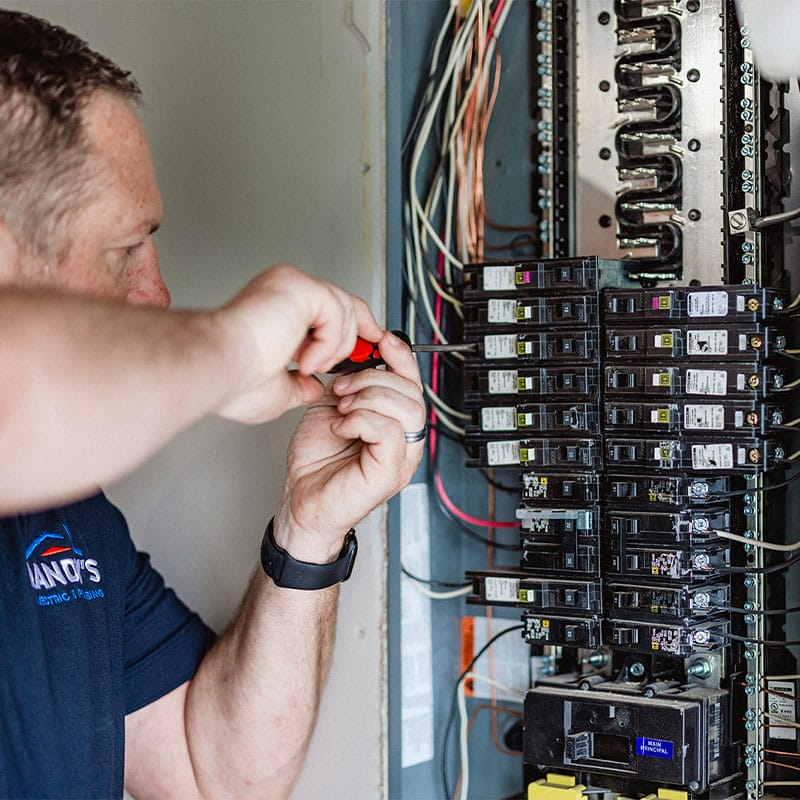
The dividing line is straightforward: if it involves opening a box, touching the panel, or running new cable, it is electrical work, it usually requires a permit, and it should be handled by someone licensed.

When Wiring or Panel Work Has To Come First
Lighting controls sit on top of a building’s existing electrical system, and they inherit its condition. A switch box with no neutral, an overloaded panel, or circuits that were never labeled correctly can all stall a controls project partway through installation. That is not an upsell, it is the reason some jobs take longer than a straightforward sensor swap.
Addressing that groundwork has value on its own, separate from the controls project, since a properly labeled panel with available capacity makes future work in the building easier regardless of what gets added next. If you want a clear picture of your building’s electrical condition before committing to a controls project, a commercial electrical inspection is a reasonable starting point.
Frequently Asked Questions About Commercial Lighting Controls
Lighting controls are less about a single gadget and more about removing the guesswork of who turns lights off and when. For a business owner or property manager, the right setup can reduce wasted lighting hours, support code compliance, and make a building easier to manage day to day.
A few practical benefits include:
Tell us about your building and how each space is used, and Randy’s Electric & Plumbing can assess your site in person to recommend the controls that make sense for it.For anything wired into the building’s permanent circuits, yes. That includes occupancy and vacancy sensors replacing existing switches, photocells on exterior lighting circuits, dimming controls, and lighting control panels. A licensed electrician is also the right call for any new switch or sensor locations those devices require.
Most often there is no occupancy or vacancy sensor installed at all, and the lights are running on a standard switch that staff forget to flip. In some older commercial buildings, the switch box also lacks the wiring a sensor needs to operate correctly, which we can confirm once we look inside the box. Either way, the fix is usually a sensor swap, sometimes paired with a small amount of additional wiring.
A few upgrades tend to have the most noticeable effect on wasted lighting hours. The two we recommend most often are:
Dimming and centralized lighting control panels add further refinement once the basics are in place, particularly in buildings with multiple zones or tenant spaces that each need their own schedule.Yes, and it is common work for us, since many commercial buildings in the Twin Cities were wired well before occupancy sensors and photocells were standard. Some spaces need groundwork first, most often a neutral wire run to a switch box, a panel with available capacity, or correctly labeled circuits. We will walk your building and tell you what it needs before any work begins.
Usually, yes. How involved the job is depends on the building’s existing panel and how many zones you want to control separately. A building with available panel capacity and accessible wiring is a more straightforward install than a multi-tenant property where several tenant suites need independent schedules. We will assess the site and price it before starting any work.
Either approach works, depending on the size of your building. Many smaller properties start with individual sensors and photocells that operate independently on each circuit. As a building grows or adds tenant spaces, a central lighting control panel can make it easier to manage schedules and overrides in one place.
Individual controls work fine for:
In many cases, yes. Most occupancy sensors, photocells, and dimmers run on existing lighting circuits without requiring new panel capacity, as long as your current system is in reasonable condition and has room to spare.
However, larger lighting control panels managing multiple zones, or buildings with panels that are already full or outdated, may need additional circuit work or a panel upgrade. One of our licensed electricians can inspect your current panel, check its capacity, and let you know what it can safely support. If upgrades are needed, we will walk you through the options before any work begins.
Yes, photocells are built to handle outdoor temperature swings and are a common fixture on commercial exterior lighting throughout the Twin Cities. What matters more is correct placement, since a photocell mounted where it picks up light from a nearby fixture or sign can cycle on and off incorrectly. We position and test photocells during installation to avoid that problem.
Frequently this means there is no photocell installed, or an existing one has failed and the fixtures are wired to run continuously instead. Replacing it with a correctly functioning photocell, or adding one where none exists, usually solves it, and in some cases the exterior lighting circuit needs attention as well.
Yes, and it is a common request for strip malls and multi-tenant office buildings, where each tenant suite may need its own hours. The approach depends on how the building is currently wired. If each suite already has its own circuits, zoning controls by tenant is usually straightforward. If lighting circuits run together across several suites, that may need to be separated first, which is a permitted piece of electrical work rather than a simple control swap.
For work that modifies your building’s wiring, meaning new control circuits, panel work, or added switch or sensor locations, generally yes, and requirements vary by city. Minneapolis, St. Paul, and surrounding municipalities each handle commercial electrical permitting a bit differently. We pull permits when needed and schedule inspections as part of the job, so you do not have to track down the requirements yourself.
Make Lighting Control Upgrades Simple With Randy’s
Sorting through sensor types, panel capacity, and scheduling options can slow a lighting controls project down. Randy’s Electric & Plumbing handles the wiring and panel work, installs the controls correctly, and makes sure the schedule matches how your building actually operates. Contact us today to schedule a lighting controls assessment for your Minneapolis or St. Paul property.
