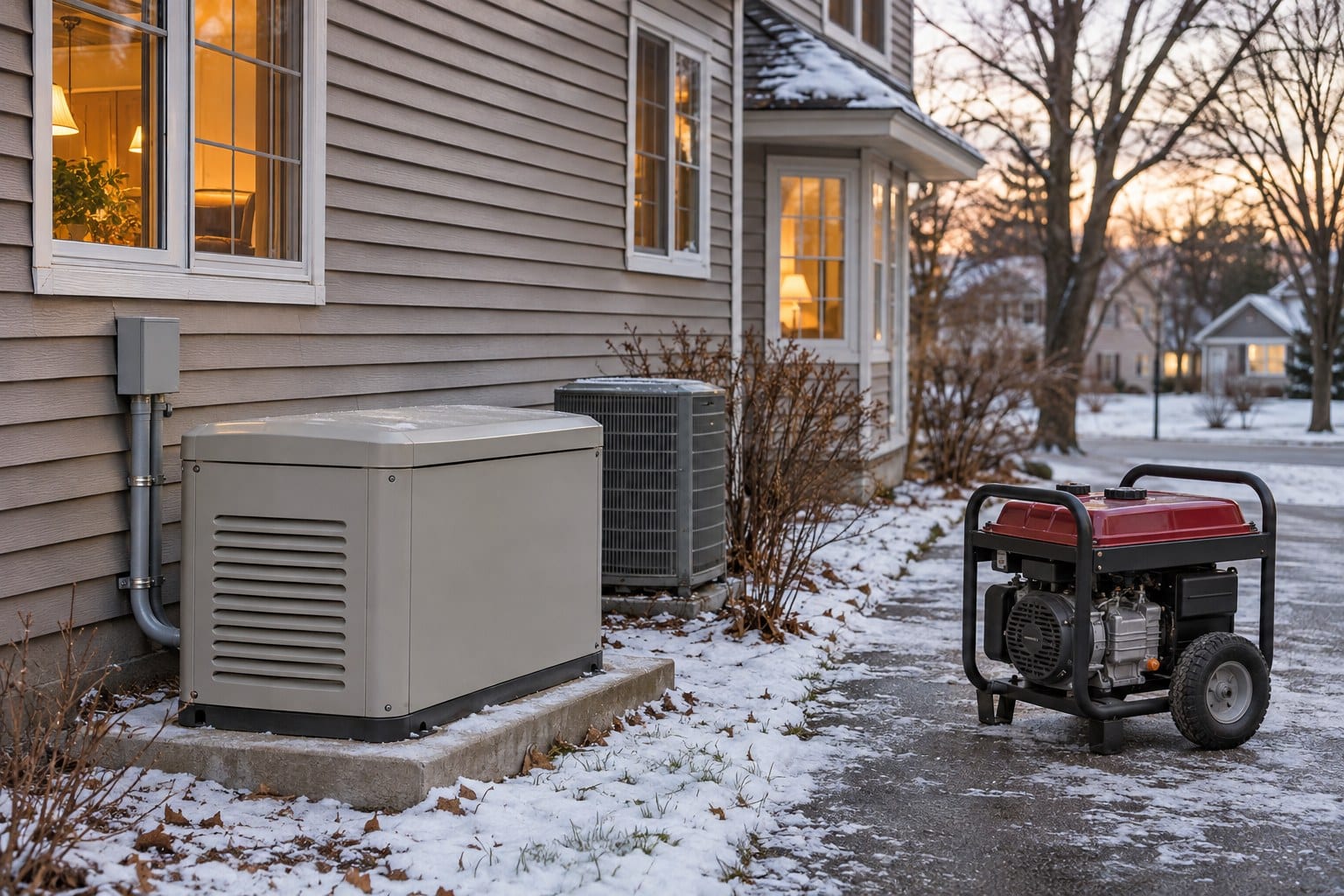
When an ice storm takes down a line in Plymouth or a July thunderstorm knocks out power across St. Paul, most homeowners ask the same question: how do we keep the house running? The answer usually comes down to two paths. One is a whole-home standby generator that starts on its own. The other is a portable generator connected through a transfer switch.
Both can keep your family comfortable. The right one depends on how your home runs, what has to stay on, and who’s around when the power goes out. Below are the same questions our team asks homeowners before we recommend anything.
The Short Answer
Choose a whole-home standby generator if you want your entire house powered automatically, central air included, if someone in your home relies on powered medical equipment, or if no one would be home to start a generator during a storm.
Choose a portable generator with a transfer switch if the essentials are enough, someone is almost always home, and you want the most budget-friendly option. That’s especially true if you already own a portable generator.
Whole-Home vs. Portable Generators at a Glance
| Whole-Home Standby Generator | Portable Generator + Transfer Switch | |
| How it starts | Automatically, usually within seconds of an outage | Someone rolls it out, starts it, and plugs it in |
| What it powers | The whole house, or the circuits you choose | Essential circuits, like the furnace, refrigerator, sump pump, and a few lights |
| Fuel | Your home’s natural gas service or a propane tank | Usually gasoline, refilled by hand during long outages |
| Who needs to be home | No one | Someone who can start and refuel it, day or night |
| Upfront investment | Higher | Lower |
| Upkeep | Yearly maintenance, plus regular automatic self-tests | Fresh fuel, test runs, and safe storage between outages |
| A good fit for | Hands-off backup power and homes with big power needs | Rare, short outages and budget-first plans |
10 Questions to Find Your Fit
Read through these and keep track of which way each answer leans. Most homes end up clearly on one side.
1. During an outage, do you want the whole house running, or just the essentials?
For most families, the essentials are the furnace, refrigerator, sump pump, and a few lights. A portable generator with a transfer switch can usually cover that. If you want the house to feel normal, central air included, you’ll need the capacity of a whole-home generator.
Leans whole-home: the whole house, including AC. Leans portable: the essentials only.
2. Do you want power to come back on its own?
A standby generator and its automatic transfer switch sense the outage and take over, usually within seconds. A portable generator needs someone to go outside, start it, and connect it, often in the dark, the cold, or the rain.
Leans whole-home: you want it automatic. Leans portable: you’re OK doing it yourself.
3. Is someone always home who could start a generator, even in a storm or at night?
Outages don’t wait for a convenient time. If you travel, work long shifts, or a portable generator would be hard for anyone in your home to move and start, automatic backup power takes that worry off the table.
Leans whole-home: no, or you’re often away. Leans portable: yes, someone’s nearly always there.
4. Does anyone in your home rely on powered medical equipment?
For most families, this question settles it. If someone depends on an oxygen concentrator or other powered medical equipment, we recommend a whole-home standby generator, so power returns without anyone having to step outside first.
Leans whole-home: yes. Leans portable: no.
5. How often do you lose power, and for how long?
If outages at your home are frequent or have lasted a day or more, a portable generator means refueling it again and again. A standby generator runs on your home’s fuel supply for as long as the outage lasts.
Leans whole-home: often, or for a day or more. Leans portable: rarely, for a few hours.
6. Do you already own a portable generator? About how big is it?
If you already own one, a transfer switch may be the most practical next step. Its size matters, though. We’ll check what your generator can realistically power so you know which circuits to connect.
Leans whole-home: no. Leans portable: yes.
7. Do you have natural gas or propane at your home?
Standby generators connect to natural gas or propane, so there are no gas cans to fill. If your home has natural gas service, or you’re open to a propane tank, a standby generator is on the table. If neither is practical, a portable may be the simpler path.
Leans whole-home: yes. Leans portable: no.
8. Do you have central air, electric heat, a heat pump, or a well pump?
These use a lot of power, and a home on a well has no running water when the pump loses power. Homes that count on this equipment usually need a whole-home standby generator sized to carry it.
Leans whole-home: yes. Leans portable: no.
9. Are you looking for the most hands-off option, or the most budget-friendly one?
Both are fair answers. A standby generator costs more up front, then takes care of itself during an outage. A portable generator with a transfer switch costs less, but asks more of you when the power goes out.
Leans whole-home: hands-off. Leans portable: budget-friendly.
10. Who else will be part of the decision?
A generator is a big decision for your home. Plan your estimate for a time when everyone making the call can be there. That way, every question gets answered in one visit, and you can compare both options together.
How to Read Your Answers
- Whole-home standby generator: if someone relies on powered medical equipment (question 4), if no one could start a portable generator (question 3), or if most of your answers lean whole-home.
- Portable generator plus a transfer switch: if most of your answers lean portable, especially if you already own one.
- A mix of both: that’s common. Book an estimate, and we’ll show you both options side by side with upfront pricing.
Generator Safety Basics
- Smell gas? Leave the house right away, and once you’re outside, call your gas utility or 911.
- Run portable generators outdoors only. Never run one in a garage, basement, or porch, even with the door open, and keep it well away from windows, doors, and vents. Generators produce carbon monoxide, which you can’t see or smell, so make sure your carbon monoxide detectors are working.
- Never plug a generator into a wall outlet. Backfeeding can send power into the utility lines, put line workers at risk, and damage your home’s wiring. A transfer switch installed by a licensed electrician prevents that.
- Power out at your house but not your neighbors’? The problem may be inside your home. Call us at (763) 560-5600. If the whole street is dark, contact your electric utility.
What Happens at Your Generator Estimate
We start with the same questions you just answered, then look at your electrical panel, your fuel service, and where a generator would sit. We calculate your home’s actual load instead of guessing, so you get the right size, not the biggest one.
Then we walk you through your options and give you one upfront price before any work begins. For a standby generator, that includes the transfer switch, installation, and the permit and inspection. Financing is available, too.
Ready to Find Your Fit?
Randy’s Electric & Plumbing is a Generac dealer serving neighbors across Minneapolis, St. Paul, and the Twin Cities metro. Our licensed, background-checked electricians install whole-home standby generators and transfer switches for portable generators, and we’re here to service them long after install day.
Prefer to talk it through? Call (763) 560-5600.
Generator FAQs
Usually not. Most portable generators are sized for essential circuits, like the furnace, refrigerator, sump pump, and a few lights. Central air, electric heat, and well pumps typically call for a whole-home standby generator.
To connect a portable generator to your home’s wiring safely, yes. A transfer switch installed by a licensed electrician keeps generator power from flowing back into the utility lines and lets you run the circuits you choose without extension cords.
Yes. Home standby generators are built to sit outside year-round and run regular self-tests, so you know they’re ready. Yearly maintenance, ideally before winter, helps keep yours dependable when an ice storm hits.
Yes, as long as the sump pump’s circuit is connected to the generator. That’s one of the most common circuits Twin Cities homeowners back up, along with the furnace. Learn more about our sump pump service.
Yes. We install, maintain, and service Generac home standby generators, and our licensed electricians install transfer switches for portable generators. Call (763) 560-5600 to schedule.